

What Criteria Does The Us Department Of Health And Human Services Use To Define Poverty
Official Poverty Measure
The Census Bureau determines poverty status by using an official poverty measure (OPM) that compares pre-revenue enhancement cash income against a threshold that is set at three times the price of a minimum nutrient nutrition in 1963 and adjusted for family unit size.
The OPM uses calculations of these three elements—income, threshold, and family—to judge what percentage of the population is poor.
The official poverty estimates are drawn from the Current Population Survey Annual Social and Economic Supplement (CPS ASEC), which is conducted in February, March, and April with a sample of approximately 100,000 addresses per year.
In 2016, the almost contempo year for which data are bachelor, the OPM national poverty rate was 12.seven percent. There were twoscore.6 million people in poverty.
Supplemental Poverty Mensurate
The Demography Bureau introduced the Supplemental Poverty Measure out or SPM in 2010 to provide an alternative view of poverty in the United States that ameliorate reflects life in the 21st century, including contemporary social and economic realities and government policy.
As its name suggests, the SPM supplements only does not supplant the official poverty measure, which remains the nation's source for official poverty statistics and for determining ways-tested program eligibility.
In a side-past-side comparison of the official poverty measure and the SPM, the Census Bureau notes their differences in measurement units, poverty threshold, threshold adjustments (e.g., by family unit size), updating thresholds, and what counts as resources, summarized in Tabular array 3 below.
| Tabular array 3. Poverty measure concepts differ between the official poverty measure and the Supplemental Poverty Measure. | ||
| Poverty Measure Component | Official Poverty Measure out | Supplemental Poverty Mensurate |
| Measurement Units | Families (run across note) or unrelated individuals | Resource units (official family definition plus whatsoever coresident unrelated children, foster children, and unmarried partners and their relatives) or unrelated individuals (who are not otherwise included in the family unit definition) |
| Poverty Threshold | Three times the cost of a minimum food diet in 1963 | Based on expenditures of food, clothing, shelter, and utilities (FCSU) |
| Threshold Adjustments | Vary by family size, composition, and age of householder | Vary by family size and limerick, too as geographic adjustments for differences in housing costs past tenure |
| Updating Thresholds | Consumer Price Index: All items | Five-year moving boilerplate of expenditures on FCSU |
| Resource Measure | Gross before-tax greenbacks income | Sum of cash income, plus noncash benefits that resources units can use to meet their FCSU needs, minus taxes (or plus tax credits), minus work expenses, medical expenses, and kid support paid to some other household |
Source: L. Fox, "The Supplemental Poverty Measure: 2016," Current Population Reports P60-261 (RV), Revised September 2017.
Annotation: "Family" as divers by the Demography Bureau is "a group of two people or more (one of whom is the householder) related by birth, spousal relationship, or adoption and residing together; all such people (including related subfamily members) are considered as members of i family unit."
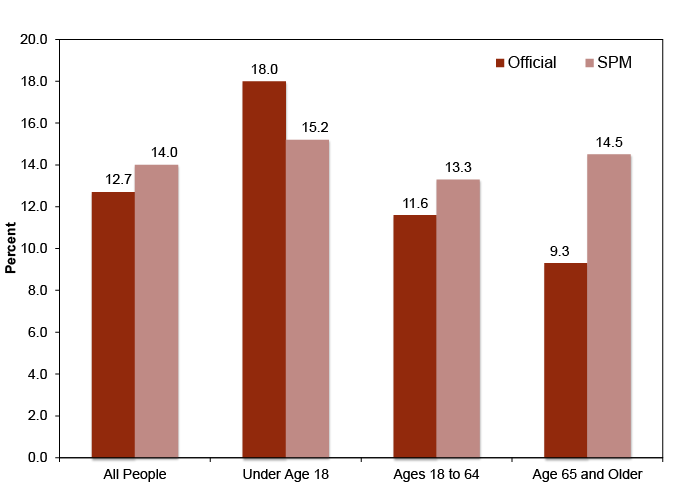
A comparison of official and SPM poverty rates in 2016 for the total population and among iii age groups: under age xviii, adults ages eighteen to 64, and elders historic period 65 and over, is shown in Figure 2.
For almost groups, SPM poverty rates were higher than official poverty rates; children are an exception with xv.2 percent poor using the SPM and xviii.0 percent poor using the official measure. Analysts attribute the lower SPM child poverty rate largely to the measure out's inclusion of noncash benefits such as Supplemental Nutrition Assist Program (SNAP, formerly Nutrient Stamps) benefits.
The much higher SPM poverty rates for people age 65 and older—14.v percent vs. 9.3 per centum using the OPM—partially reverberate that the official thresholds are prepare lower for families with householders in this historic period group, while the SPM thresholds practise not vary by age.
In addition, the SPM charge per unit is college for people age 65 and older because it includes out-of-pocket medical expenditures, which are typically high for the elderly, whereas the official measure does not take them into account.
Figure 2. Poverty rates using OPM and SPM measures for total population and by age grouping, 2016, testify a higher OPM child poverty rate and higher SPM elderly poverty rates.

What Criteria Does The Us Department Of Health And Human Services Use To Define Poverty,
Source: https://www.irp.wisc.edu/resources/how-is-poverty-measured/
Posted by: ponderinateptind.blogspot.com
0 Response to "What Criteria Does The Us Department Of Health And Human Services Use To Define Poverty"
Post a Comment