

Which Of These Government Organizations Provides The Most Direct Health Services To A Population?
Population health management (PHM) strives to reach IHI's Triple Aim, including better outcomes for individuals across communities. Health systems working to improve healthcare outcomes tin can meet their goals past aligning improvement and PHM strategies. This article describes how organizations can use iv PHM strategies to transform their approaches to data, analytics, payment, and intendance to improve outcomes and achieve sustainable change.
The Population Health Strategies–Outcomes Improvement Connection
While many organizations define population health slightly differently, its core aim is to improving health outcomes of individuals and populations while improving efficiencies and reducing the total costs. IHI references a definition from population health researcher David Kindig: "Population health is defined as the wellness outcomes of a group of individuals, including the distribution of such outcomes inside the group." Kindig explains that populations "are ofttimes geographic populations such as nations or communities, merely tin can likewise exist other groups such every bit employees, ethnic groups, disabled persons, prisoners, or any other defined group."
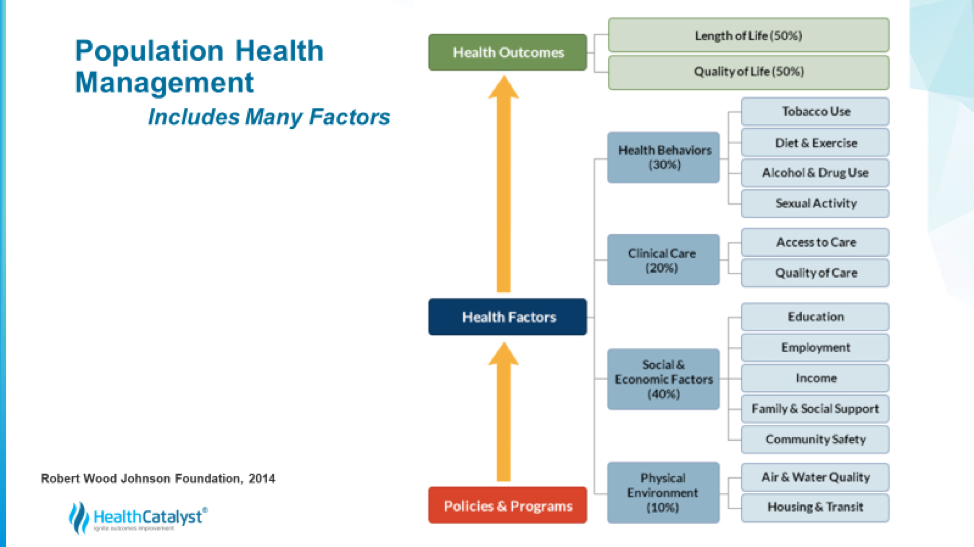
Regardless of how organizations ascertain population strategies, PHM involves collaboration betwixt leaders in healthcare, politics, charity, pedagogy, and concern. Factors that brand upwards the complete moving picture of individual and population health (Effigy 1) span health behaviors (e.g., tobacco utilize, diet and exercise, and booze and drug employ), clinical intendance (eastward.g., admission to care and quality of care), social and economic factors (eastward.one thousand., education, income, and family unit and social back up), and the concrete environment (due east.k., air and water quality and housing and transit).
Iv Population Health Management Strategies that Bulldoze Outcomes Comeback
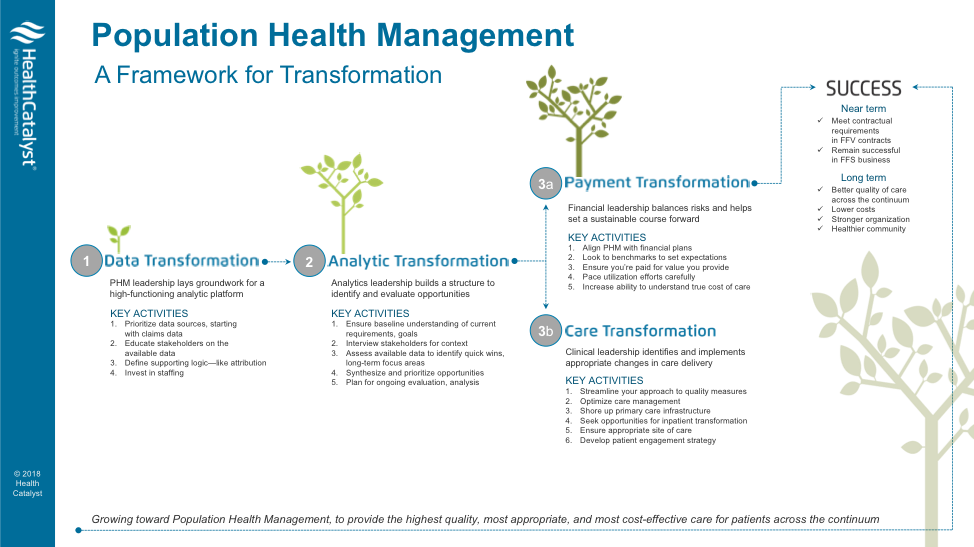
In that location are four PHM strategies organizations can use (Figure 2) to improve outcomes:
Strategy #one: Data Transformation
Organizations must exist able to prioritize and integrate a multitude of internal and external data sources to provide better transparency into the population wellness journey. This transparency helps organizations improve manage their networks, risks, opportunities, and strategies to efficiently ameliorate health. The team working on the Alberta Health Services population health initiative concluded that only eight percent of the information needed for precision medicine and population health resides in today's EHRs. This highlights the need to incorporate not only clinical information, merely also data related to health behaviors, social and economic information, physical ecology data, claims information, cost data, appointment information, and a variety of boosted sources. Practically speaking, this data tin can provide critical direction on ensuring commitment of the right services at the right fourth dimension in the right identify.
Strategy #two: Analytic Transformation
One time organizations have the right data to identify and evaluate opportunities for population health and improvement work, they will need an analytic structure that tin can deliver several key capabilities:
- The ability to produce a baseline understanding of the target population. Further analysis can help synthesize and prioritize opportunities. For example, to lower rates of preterm births, health systems demand to understand the prevalence of early births in the population. Diving into the data further may identify counties or geographic locations where the prevalence is high and available services are express.
- The ability to refine the definition of a population and target the right people who could benefit from an intervention. For example, to accurately capture the number of children in a population with asthma, an arrangement must look beyond diagnostic codes and consider signs, symptoms, and pharmacy information.
- The ability to identify improvement opportunities based on variation in care. For example, identifying variation related to adherence in prescribing all-time practice medications for a specific status.
- The power to sympathize the total cost of care beyond the continuum versus the cost in a vertical setting (merely the hospital or merely the clinic). For example, understanding the full cost of care for an orthopedic process should include pre-rehab, medications, supplies, inpatient costs, mail service-rehab, medications, supplies, clinic costs, readmissions, complications, etc.
- The ability to program for ongoing analysis to ensure initiatives are impacting the identified opportunity areas.
Strategy #3: Payment Transformation
Organizations must transform their fee-for-service payment models to ameliorate empathise the total toll of care and to balance the run a risk health that systems presume under value-based contracting and population wellness. If organizations switch to value-based care models, but don't take the payment system to support the shift, they tin't improve the wellness of individuals and populations. Systems must fully understand the total cost of care and be able to expect at risk contracts to ensure they're properly paid for the services they evangelize.
Strategy #4: Care Transformation
Under care transformation, organizations optimize care management processes and outcomes to support individuals beyond the continuum of care. For example, Cradle Cincinnati, an organization committed to improving infant wellness in the Cincinnati area, sought to accost the rate of preterm births, and associated deaths and complications, in the local community. By embracing the PHM strategy of care transformation, Cradle Cincinnati identified smoking and inadequate spacing betwixt nascence every bit modifiable behaviors impacting preterm births (and the opportunity to salve more than $25 million per year). Instead of targeting merely women who were significant, the arrangement approached the continuum of pregnancy care by providing women in the community who could become pregnant with a healthy pregnancy instruction entrada.
Other care transformation comeback opportunities include strengthening main care infrastructure, ensuring that appropriate intendance is given in the correct place at the correct fourth dimension, and improving engagement of individuals and caregivers.
Population Wellness Direction Strategies Amend Outcomes
The following success stories show how health systems are actively using PHM strategies to improve outcomes:
Opportunity Analysis Permits Successful Execution of At-Gamble Contracts
As healthcare organizations face up a ascent in at-risk contracts, they increasingly work toward the PHM goals of reducing healthcare costs and improving patient outcomes and feel. Allina Health used its analytics platform to combine several data sources, including claims data, to identify opportunities to subtract the full price of care and better outcomes across the care continuum.
Turning Child Diabetes Management into a Customs Crusade
Patients with diabetes are at a loftier risk for infections and substantial complications, including the risk of expiry from infections. Further, social determinants in these patients' communities have a tremendous influence on their health. Texas Children's Hospital identified gaps in diabetes care coordination in the community. With the support of an analytics platform, the hospital initiated a coordinated community response to prepare the standard for customs management of pediatric diabetes. As a result, it improved clinician knowledge of pediatric diabetes by more 26 percentage and made individualized schoolhouse packets bachelor in the EHR to 90 percent of patients.
Intendance Direction: A Disquisitional Component of Constructive Population Health Management
Unprecedented changes in the healthcare payment system are driving organizations to develop effective PHM strategies. Leading health systems are implementing data-driven care management programs to reduce healthcare costs and improve patient outcomes and feel. Information-driven care management programs that target high-run a risk and rising-take chances patients can achieve impressive results:
- Upwards to 20 pct lower rates of hospitalization in mature care management programs.
- Lower rates of emergency section utilization.
- Decreased costs.
Population Wellness Management: A Big-Picture show Approach to Improvement
With PHM strategies, organizations approach comeback from a broader continuum-care-care perspective. Instead of focusing improvement resources on express populations and acute care, effective PHM strategies bulldoze transformation that addresses all levels of healthcare delivery, including prevention and care direction.
To brainstorm the PHM journey and ensure that PHM strategies truly impact outcomes comeback, organizations must commit to fully agreement the PHM strategies (data, analytic, payment, and intendance transformation) that align with outcomes improvement and apply them to areas with the greatest opportunity for improvement.
PowerPoint Slides
Would you lot like to use or share these concepts? Download this presentation highlighting the key main points.
Click Here to Download the Slides

Which Of These Government Organizations Provides The Most Direct Health Services To A Population?,
Source: https://www.healthcatalyst.com/insights/4-population-health-strategies-drive-improvement
Posted by: ponderinateptind.blogspot.com
0 Response to "Which Of These Government Organizations Provides The Most Direct Health Services To A Population?"
Post a Comment